
Last & Lonely:
strategies for selling stragglers

When a retailer has a single unit left from a collection of merchandise, one strategy is to turn that scarcity into a sale without making the product feel unwanted or the need for deep discounting. In theory, a last-one-left frequently exists because a collection sold well. Continue reading for strategies that involve displaying and positioning any stragglers to preserve profitably.
Last One Left opportunities
At J. Alden in Connecticut, a “last one left” is viewed as a merchandising opportunity, rather than a clearance problem.
“One of the merchandising ideas that has worked really well in my boutique is something I call Last & Lonely.” ~Amy D’Alessio, J. Alden Womens in Essex, CT
As styles sell down, J. Alden owner Amy D’Alessio gathers one piece remaining items and displays them together in a dedicated section labeled Last & Lonely. It creates a fun shopping experience and draws attention to pieces that might otherwise be overlooked on the sales floor.
“The key is that these are not old clearance items. They’re current, brand-new pieces that were so popular they sold quickly, leaving just one size or one item behind. Because there’s only one left, I offer them at 20% off as a little incentive for customers to take home that final piece.” ~Amy D’Alessio
The concept is successful because J. Alden customers feel like they’re discovering a hidden treasure, and it’s a simple way to sell the singles while keeping the presentation fresh and engaging.
Creating a game plan for “Last One Left” inventory:
Promote scarcity
Create a “Last One Left” section and choose messaging that indicates a special rack or dedicated area. (I’ll provide a list of messaging ideas later in this post.)
Rather than presenting the items as leftover merchandise, position them as an opportunity, giving customers a location and reason to browse merchandise that might otherwise be overlooked.
Use the same signage as throughout your store, instead of clearance-style signs.
For your website or online store, utilize a low-stock or last-one indicator.
Use “Last One Left” as a selling point
Train associates to emphasize the scarcity:
“That’s actually our last one. That collection/design/scent/pattern/color has been really popular, but we cannot reorder.”Feature last ones in email or social media.
A single, remaining item is perfect for short-form content, because it creates a time-sensitive call-to-action.
Move “Last Ones Left” to a high-traffic location
Display your last ones rack/items where customers generally linger when shopping; near fitting rooms, by related/best-selling merchandise, near the checkout.
A last one left may become an impulse purchase when customers see it at the right moment.
Know when to reclassify from“Last Ones Left” to clearance.
Try “Last One” messaging before heavily discounting. If final items are slow-moving, start with a modest incentive.
If an item has been around for too long, the cost of keeping it on the sales floor outweighs the potential profitability of waiting for a full price purchase.
Establish a markdown threshold (e.g., by date or season) rather than making the decision randomly or emotionally.

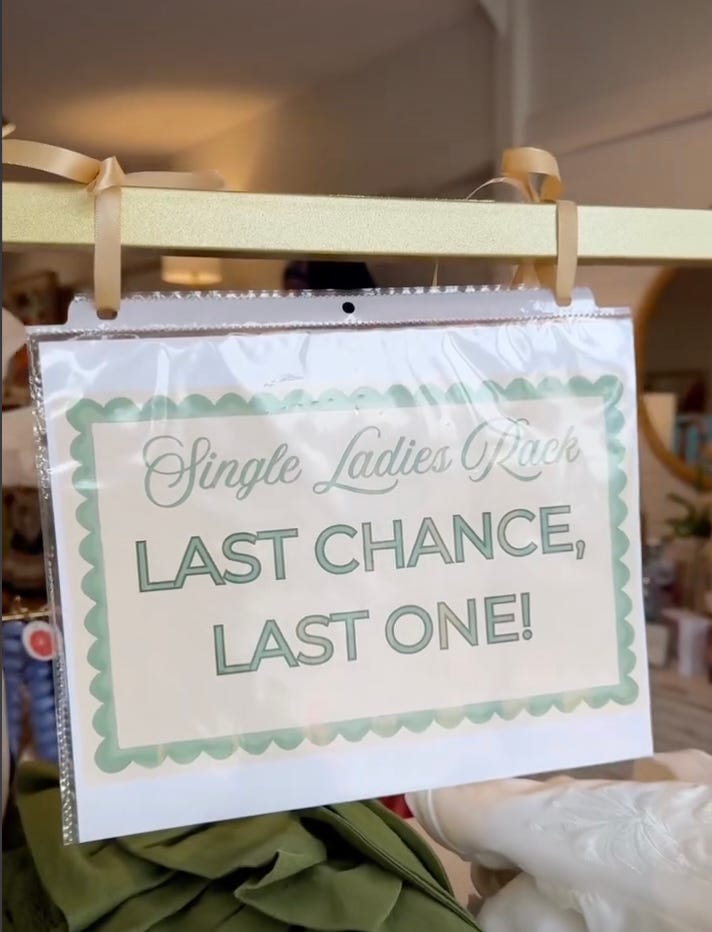


Last Ones messaging currently being used by Retail Details subscribers:
Last and Lonely
Single Ladies Rack
Last One Left
Solo Styles
Final Finds
Stragglers Sale
Last-on-the-Rack!
Onesie Rack
Final Few
Last Chance Rack
In conclusion:
Selling “Last One Left” merchandise can be profitable using the following progression:
Scarcity → Specific placement → Promotion → Small incentive → Markdown
If you find this post helpful, please click the like♡heart below. It helps us in planning future retail tips topics.
From my small business to yours, stay retail inspired, friends!
~Becky Tyre, Retail Details